
A Marriage Certificate is an official document issued by the government that legally records a marriage. It serves as proof of marriage and is required for various purposes such as applying for a passport, visa, bank account updates, insurance claims, property matters, and government benefits.
This guide explains how to apply for a Marriage Certificate in India, eligibility, required documents, fees, and the registration process.
What Is a Marriage Certificate?
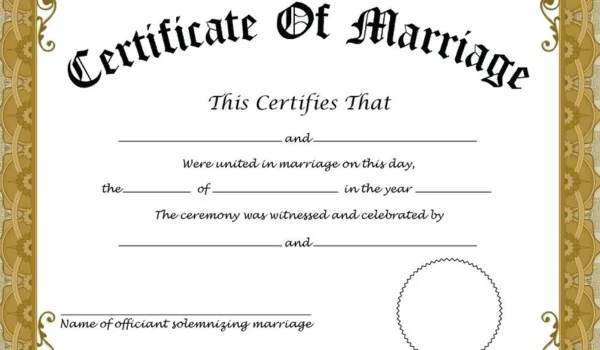
A Marriage Certificate is a legal document issued by the Marriage Registrar or the competent authority after a marriage is registered under the applicable law.
It generally contains:
- Names of the bride and groom
- Date of marriage
- Place of marriage
- Registration number
- Date of registration
- Signature and seal of the issuing authority
Why Is a Marriage Certificate Important?
A Marriage Certificate is commonly required for:
- Passport applications
- Visa and immigration purposes
- Changing surname after marriage
- Opening joint bank accounts
- Insurance claims
- Property and inheritance matters
- Applying for family pension
- Government schemes
- Court proceedings
Who Can Apply?
A couple can apply for marriage registration if:
- Both parties meet the minimum legal age (currently 21 years for the groom and 18 years for the bride, unless the law is amended in the future).
- Both parties are legally eligible to marry.
- The marriage has been solemnized according to applicable personal laws or under the Special Marriage Act, 1954, where applicable.
Documents Required
The required documents may vary by state, but generally include:
- Aadhaar Card of both spouses
- PAN Card (if available)
- Proof of age (Birth Certificate, Passport, Class 10 Certificate, etc.)
- Address proof of both spouses
- Passport-size photographs
- Wedding invitation card (if available)
- Marriage photographs
- Identity proof of witnesses
- Affidavit (if required by the local authority)
How to Apply for a Marriage Certificate
Step 1: Visit the Marriage Registration Office
Apply at the office of the:
- Marriage Registrar
- Sub-Registrar
- Municipal Corporation
- Local Registration Authority
Many states also offer online registration through their official portals.
Step 2: Fill Out the Application Form
Provide details such as:
- Names of both spouses
- Date and place of marriage
- Address
- Date of birth
- Religion (where required)
- Contact details
Check all information carefully before submission.
Step 3: Submit Documents
Attach the required documents along with the application form.
Carry the original documents for verification if applying offline.
Step 4: Witness Verification
Most states require two or three adult witnesses to be present during the registration process. Witnesses should carry valid identity proof.
Step 5: Pay the Registration Fee
Pay the prescribed registration fee.
The amount varies depending on the state and the law under which the marriage is registered.
Step 6: Certificate Issuance
After verification and approval, the Marriage Certificate is issued.
In many states, you can also download a digitally signed certificate from the official portal.
Processing Time
The processing time depends on the state and the applicable law.
In many cases, the certificate is issued within 7 to 30 days, provided all documents are complete and there are no legal objections.
Marriage Registration Under Different Laws
| Law | Applies To |
| Hindu Marriage Act, 1955 | Hindus, Buddhists, Jains, and Sikhs |
| Special Marriage Act, 1954 | Interfaith marriages and civil marriages, or couples choosing registration under this Act |
| Other Personal Laws | Christians, Muslims, Parsis, and others, as applicable |
Common Reasons for Application Rejection
Applications may be delayed or rejected due to:
- Incorrect information
- Missing documents
- Incomplete application form
- Invalid identity proof
- Witnesses not available
- Failure to meet legal eligibility requirements
FAQs
Is a Marriage Certificate mandatory?
Marriage registration requirements vary depending on the applicable law and state rules. However, obtaining a Marriage Certificate is strongly recommended as it serves as important legal proof of marriage.
Can I apply online?
Yes. Many State Governments provide online marriage registration services through their official portals.
How many witnesses are required?
Most states require two or three adult witnesses, depending on local rules.
Can I get a Marriage Certificate years after marriage?
Yes. In many cases, marriages can be registered even after several years, subject to the applicable legal requirements and submission of supporting documents.
Conclusion
A Marriage Certificate is one of the most important legal documents for married couples in India. It serves as official proof of marriage and is useful for passports, visas, banking, insurance, inheritance, and many other legal purposes. By submitting the required documents, completing the verification process, and registering your marriage with the appropriate authority, you can obtain your certificate smoothly. Before applying, always check the latest guidelines and fees on your State Government’s official marriage registration portal.