
A Legal Heir Certificate is an important government document issued to identify the legal heirs of a deceased person. It is commonly required for claiming property, transferring bank accounts, receiving pension benefits, insurance claims, government dues, and other financial assets.
If a family member has passed away, obtaining a Legal Heir Certificate can help establish the relationship between the deceased and the surviving legal heirs. This guide explains how to apply for a Legal Heir Certificate in India, the required documents, eligibility, fees, and the application process.
What is a Legal Heir Certificate?
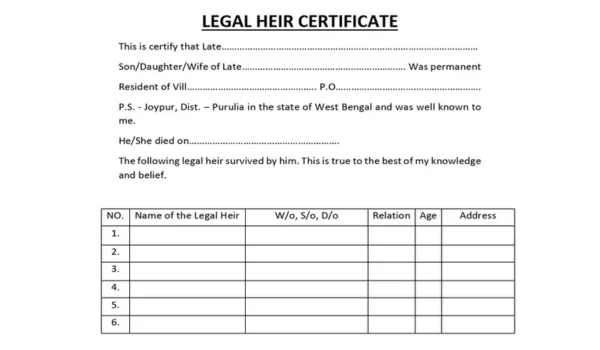
A Legal Heir Certificate is an official document issued by the competent authority that certifies the legal heirs of a deceased person. It is generally used to settle financial and administrative matters after a person’s death.
The certificate usually includes:
- Name of the deceased
- Date of death
- Names of the legal heirs
- Relationship with the deceased
- Residential address
Who Can Apply for a Legal Heir Certificate?
Generally, the following family members can apply:
- Spouse (Husband or Wife)
- Son
- Daughter
- Mother
- Father (in certain cases)
- Other legal heirs as recognized under the applicable personal law
The list of eligible heirs may vary depending on the succession laws applicable to the deceased.
Uses of a Legal Heir Certificate
A Legal Heir Certificate is commonly required for:
- Transfer of property
- Bank account settlement
- Claiming insurance benefits
- Pension transfer
- Employee salary or service benefits
- Provident Fund (PF) claims
- Government compensation
- Utility connection transfer
- Mutation of property records (in some states)
Note: For disputes involving inheritance, immovable property ownership, or succession to assets, a Succession Certificate or other court-issued documents may also be required depending on the nature of the asset.
Documents Required
Keep the following documents ready:
- Death Certificate of the deceased
- Aadhaar Card of the applicant
- Identity proof of all legal heirs
- Address proof
- Family Ration Card (if applicable)
- Self-declaration or affidavit (if required)
- Passport-size photographs
- Mobile number
- Any additional documents required by the State Government
How to Apply for a Legal Heir Certificate
Step 1: Obtain the Application Form
You can apply:
- Through the State Government’s online service portal (where available), or
- By visiting the Tehsildar, Taluk Office, Revenue Office, or designated authority in your area.
Step 2: Fill the Application Form
Provide details such as:
- Name of the deceased
- Date of death
- Last residential address
- Details of all legal heirs
- Relationship with the deceased
- Applicant’s contact details
Ensure that all information matches the supporting documents.
Step 3: Attach Required Documents
Submit photocopies of the required documents along with the application.
Carry the original documents for verification if applying offline.
Step 4: Pay the Application Fee
Some states charge a nominal application or service fee, while others may issue the certificate free of cost.
The fee varies from state to state.
Step 5: Verification Process
After submission:
- Revenue officials may verify the documents.
- Local enquiries may be conducted if required.
- Authorities verify the relationship between the deceased and the applicants.
Step 6: Receive the Certificate
Once verification is complete and the application is approved, the Legal Heir Certificate is issued.
In many states, applicants can also download the certificate online.
Processing Time
The processing time generally ranges from 15 to 30 days, depending on the state, verification process, and workload of the concerned authority.
Difference Between Legal Heir Certificate and Succession Certificate
| Legal Heir Certificate | Succession Certificate |
| Issued by Revenue Authorities | Issued by a Civil Court |
| Identifies legal heirs | Grants authority to claim certain debts and securities |
| Used for pensions, service benefits, and administrative purposes | Used mainly for movable assets such as bank deposits, shares, and securities |
| Faster and simpler process | Court procedure may take longer |
Common Reasons for Application Rejection
Your application may be rejected if:
- Incorrect information is provided.
- Required documents are missing.
- Death Certificate is not submitted.
- Relationship details cannot be verified.
- There are disputes among legal heirs.
FAQs
Who issues a Legal Heir Certificate?
It is generally issued by the Tehsildar, Revenue Department, or another competent authority designated by the respective State Government.
Can I apply online?
Yes. Many states provide an online application facility through their official citizen service portals.
Is a Legal Heir Certificate mandatory?
It is not mandatory in every situation, but it is often required for claiming pensions, insurance, government benefits, and transferring certain assets.
How long is a Legal Heir Certificate valid?
A Legal Heir Certificate generally does not have an expiry date unless it is cancelled or modified by the competent authority.
Conclusion
A Legal Heir Certificate is an essential document that helps the surviving family members claim government benefits, insurance, pensions, bank accounts, and other assets after the death of a family member. By submitting the required documents, completing the verification process, and applying through the appropriate state authority, eligible applicants can obtain the certificate with relative ease. If there is a dispute regarding inheritance or ownership of assets, you should seek legal advice, as a Succession Certificate or court order may be required depending on the circumstances.